
Siding Repair That Matches Your Home and Stops Water Behind the Wall
Siding Repair for Cracked, Loose and Storm-Damaged Siding
A cracked panel, a section that blew loose in a windstorm, or a dented strip by the driveway usually means one thing: water now has a path behind your siding. Home Pro Roofing handles siding repair for homeowners across Michigan, Ohio, Wisconsin and Indiana, from a single damaged course to a full storm-damaged wall. We replace what is broken, check the house wrap and sheathing underneath, and match the new material to the old as closely as the product allows.
Most siding problems we see do not need a whole new exterior. When the rest of the wall is sound, a targeted repair costs far less and keeps your home protected. When the damage points to a bigger problem, we tell you that plainly. Home Pro Roofing has been in business for more than 25 years, and we offer a full range of siding services, so our advice is never shaped by a single service we are trying to sell.
Signs Your Siding Needs Repair
Siding damage is easy to ignore because the wall still looks mostly fine from the street. These are the signs that tell us a repair should happen before the next season of weather:
- Cracks, holes or chips from hail, a mower or a thrown stone. Even a small hole lets wind-driven rain reach the wall.
- Loose or unlocked panels that flap or bow after a windy day, often near corners and the top course.
- Warped or wavy sections, which usually mean panels were nailed too tight to move with temperature.
- Soft spots or staining below windows, at the base of downspouts or along the bottom course, a sign that moisture is already reaching the sheathing.
- Damaged trim at corner posts, J-channel or the fascia boards behind the gutters, where siding and roofline details meet.
If you see more than one of these on the same wall, that is the time to have it looked at rather than waiting for spring.
What Midwest Weather Does to Siding
Siding in our area takes a harder beating than the same product in a milder climate. Vinyl is the most common exterior on new homes in our region: the National Association of Home Builders found vinyl on 68% of new homes built in the East North Central states in 2022, the census division that covers Michigan, Ohio, Wisconsin and Indiana. So most of the repairs we make involve vinyl, along with fiber cement and composite.
Three things drive most of the damage. First, temperature swings: vinyl expands in summer heat and contracts in a January cold snap, and panels that cannot move freely buckle or pull loose. The Vinyl Siding Institute’s installation manual calls for leaving roughly 1/32 inch between the nail head and the panel so it can slide, and many of the loose or wavy walls we repair were nailed tight. Second, snow and ice: around Grand Rapids, average yearly snowfall rose to 77.6 inches under the 1991-2020 climate normals, and lake-effect snow piles drifts against lower walls for weeks. Third, storms: hail and straight-line winds crack brittle older panels and unlock whole courses at once.
Homeowners near our Grand Rapids roofing and exterior team see the lake-effect side of this most often, while homes around Madison deal with long, hard freezes. The repair method is the same; what changes is how quickly a small crack turns into a soaked wall.
The Repairs We Handle Most
Every siding repair starts with finding out why the siding failed, because replacing a panel without fixing the cause just schedules the next repair. Here is the work we do most often.
Vinyl Panel Replacement
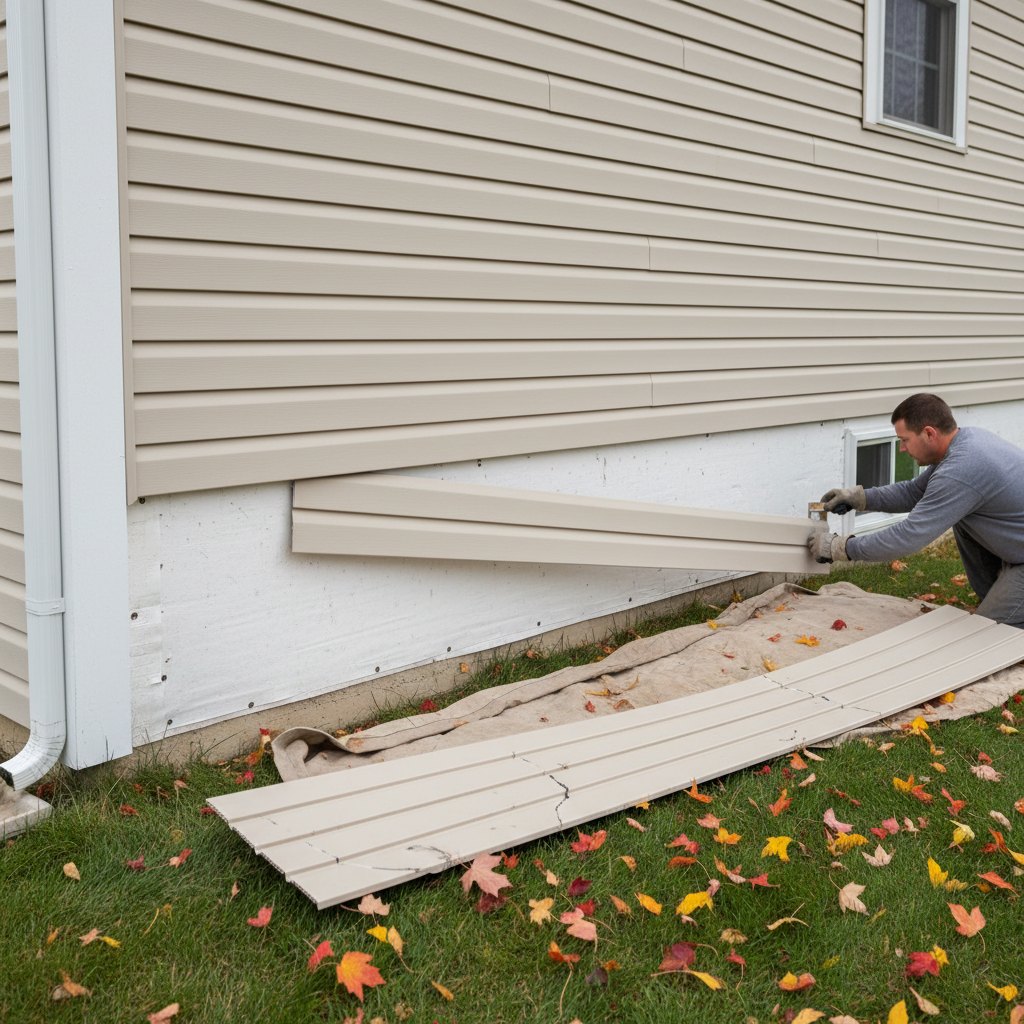
Vinyl courses interlock, so a damaged piece can usually be removed without disturbing the rest of the wall. We unlock the course above with a siding tool, remove the damaged panel, check the house wrap behind it, then hang a matching panel with proper nail spacing and zip the wall closed again.
Fiber Cement and Composite Repairs
Cracked or chipped fiber cement boards are cut out and replaced board by board, then sealed, caulked at the right joints and painted to match. If your home has James Hardie fiber cement siding, we follow the manufacturer’s clearance and fastening details on the replacement boards. Composite siding repairs follow the same idea with the product’s own trim and fastener rules.
Corner Posts, J-Channel and Trim
Corner posts and J-channel around windows are where water most often gets behind siding. We repair or replace damaged trim pieces and re-flash openings when the original flashing is missing or torn.
Sheathing and House Wrap Behind the Damage
When we open a damaged area and find wet or soft sheathing, we show you, explain the scope, and replace the affected section before new siding goes back on. Covering rot with new panels only hides the problem.
Water Coming Off the Roofline
Overflowing or leaking gutters are one of the most common causes of stained, rotting siding near the foundation. If that is the source, a gutter repair or re-pitch belongs in the same visit, since new siding under a leaking gutter will fail the same way.
Repair or Replace, and Why Matching Matters
A repair makes sense when the damage is limited to one area and the rest of the siding is still in good shape. As a rule of thumb, siding under about 15 years old with isolated damage is a repair job. When fading, warping or moisture problems show up across several walls, or the product is so old that nothing close to it is made anymore, full siding replacement is usually the better use of your money because it fixes the whole envelope at once.
Color and profile matching is the honest sticking point with any repair. Siding fades with sun exposure, manufacturers retire colors, and profiles change over the years. When an exact match is not available, we lay out the options: use the closest current product on a less visible wall, or move good panels from a hidden wall (behind a garage or deck, for example) to the damaged front and put the new panels where they will not be noticed. If you are planning an addition, we can also tie the repair into new siding installation on that section so the whole elevation reads as one.
What Siding Repair Costs
Siding repair cost depends on the material, how many courses are damaged, how high the damage sits on the wall and what we find behind it. HomeAdvisor’s 2026 cost data puts a typical siding repair at $367 to $1,524, with an average around $928. Use that as a planning range only; your written estimate is based on your home.
What moves the price up or down:
- Material. Vinyl panels are the least expensive to replace. Fiber cement and composite cost more per board and need painting or matched trim.
- Height and access. A first-floor repair is quick. A second-story gable needs ladders or staging and more labor.
- Hidden damage. Wet sheathing or rotted framing behind the siding adds to the scope. We document it with photos before any added work.
- Matching. Sourcing a discontinued color, or moving panels from another wall, takes extra time.
Every estimate we give is written, clear and detailed before work starts. For larger storm repairs, financing through Slice is available to qualifying homeowners.
Storm Damage Siding Repair and Insurance Claims
Storm damage siding repair is its own kind of job, because the insurance paperwork matters as much as the panels. Hail tends to crack and dent siding on the side of the house that faced the storm, while high winds unlock whole courses. If a storm also damaged your roof, our emergency roof repair team can tarp and secure it first, then we handle the siding.
Michigan’s Department of Insurance and Financial Services recommends a few steps after severe weather: report the claim to your insurer, photograph or video the damage, and keep receipts for anything you buy to prevent further damage. We add to that with our own photo documentation and a written repair estimate your adjuster can compare against. Our guide to roof and storm insurance claims covers what to expect from the adjuster visit.
How a Repair Visit Works
We follow the same eight-step process we use on every roofing project, adapted for siding work:
- Free, no-pressure inspection. We look at the damaged area, the walls around it, the trim and the gutters above it, and photograph what we find.
- Material and color match. We identify the siding profile and color and check what is still available before quoting.
- Written proposal and one point of contact. You get a clear, detailed estimate and a project manager who handles scheduling and questions.
- Permits and job prep. Most small repairs do not need a permit; larger sections might. We confirm with your local building department and set up drop cloths to protect landscaping.
- Remove damaged siding and inspect behind it. We open the area, check house wrap and sheathing, and walk you through anything hidden before going further.
- Install matched siding and trim. New panels or boards go up with correct fastening, flashing at openings and sealed trim.
- Cleanup and walkthrough. We remove debris, sweep for nails and walk the finished repair with you.
- Documentation. You get photos of the completed work and paperwork for your insurer if the repair is part of a claim.
Why Homeowners Choose Home Pro Roofing as Their Siding Repair Contractors
Plenty of siding repair contractors will patch a panel. What sets our work apart is that we look at the whole exterior system, because siding, gutters, fascia and roofline flashing all affect each other. One company handles all of it, so you are not coordinating three trades for one leak.
Michigan requires contractors who repair or remodel homes to hold a state license, and local building departments, such as Muskegon Charter Township, remind homeowners to check it. Before you sign with any contractor, confirm their license is current. The state’s building permit guidance also notes that ordinary repairs do not need a permit, which covers most small siding fixes. We confirm the requirement for your address anyway, so there are no surprises if the scope grows.
You also get the basics every homeowner should expect: a written estimate before work begins, a crew who explain what they found, and a clean site when we leave.
Frequently Asked Questions About Siding Repair
These are the questions homeowners ask us most when a section of siding is damaged.
Can you replace one damaged section of vinyl siding without redoing the whole wall?
Yes, in most cases. Vinyl courses lock into each other, so we can unlock the course above, remove only the damaged panels and install new ones without touching the rest of the wall. The main limit is matching the color and profile of the existing siding.
What happens if my siding color has been discontinued?
We check current products first, since many colors have close equivalents. If nothing matches well, we can move panels from a hidden wall to the damaged visible area and use the new panels where they will not be noticed, or we can talk through replacing one full elevation so it reads as a deliberate change.
Why does my vinyl siding keep coming loose in the same spot?
Repeat failures usually come from how the panels were fastened. Siding nailed too tight cannot move with temperature changes and buckles, while panels that missed the nailing strip or were not locked fully pop out in wind. We refasten the area to the manufacturer’s spacing rather than just snapping the panel back in.
Will insurance pay for hail-damaged siding if only one side of the house was hit?
It depends on your policy and the adjuster’s findings. Many claims cover the damaged elevation, and policy language on matching the rest of the house varies by insurer. We document the damage and provide a written estimate so you and your adjuster are working from the same facts.
How soon should cracked siding be repaired?
Before the next freeze or heavy rain if you can. A crack lets wind-driven rain reach the house wrap and sheathing, and water that gets in during fall can freeze, expand and widen the gap over the winter. A quick repair now usually costs far less than replacing wet sheathing in spring.
Get a Free, Written Estimate
Whether it is one cracked panel or a wall full of storm damage, we will tell you what it needs and what it costs, in writing, before any work starts. We serve homeowners across Michigan, Ohio, Wisconsin and Indiana, including the communities around our metro Detroit roofing and exterior branch and our Madison, Wisconsin team. Request your free siding repair estimate today and we will set up a time to take a look.